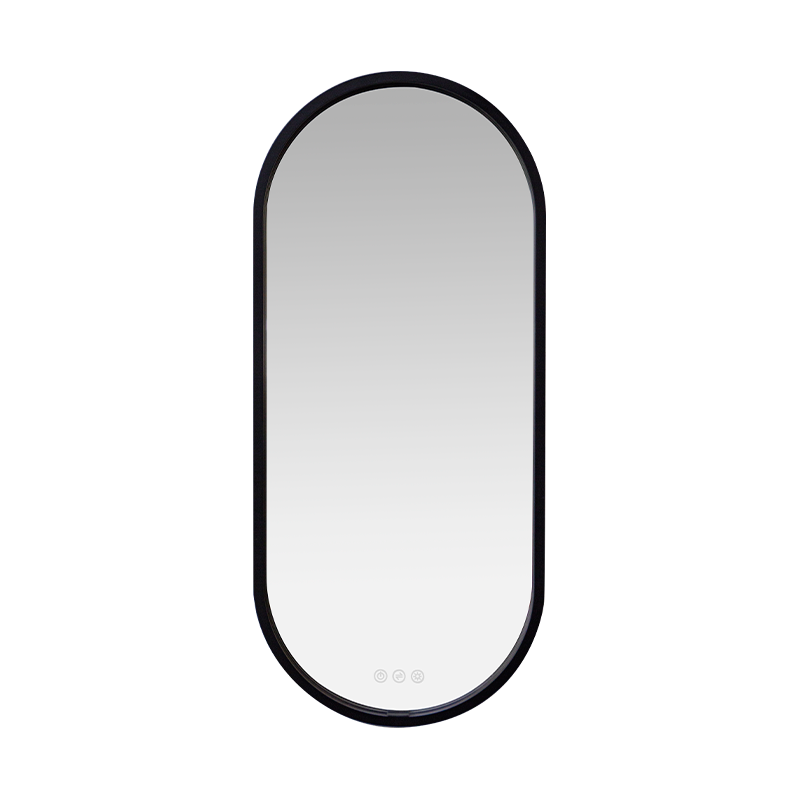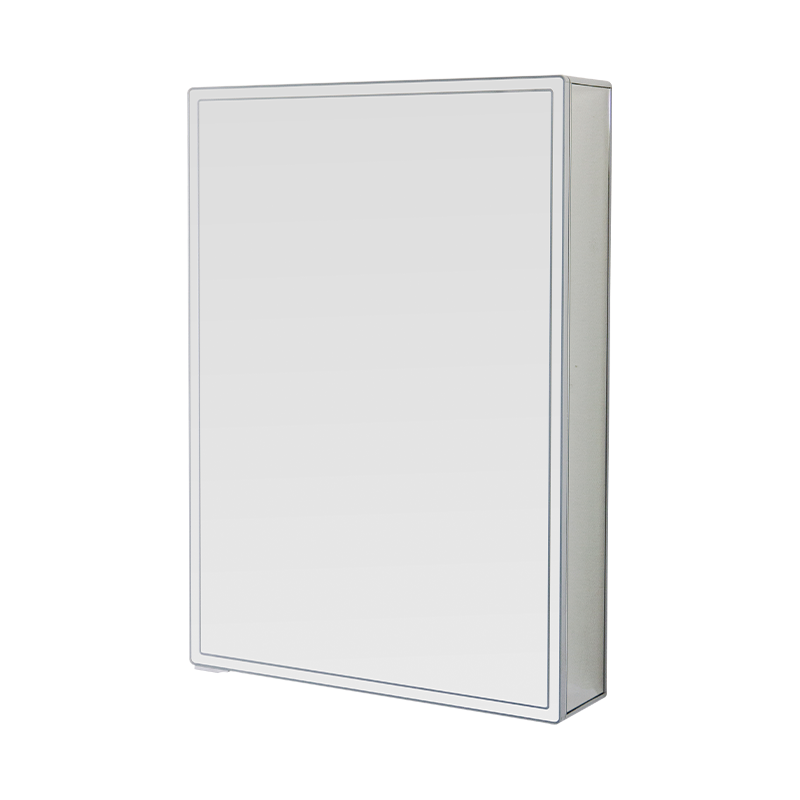

What Is a Frameless Minimalist LED Mirror?
Walk into a bathroom at seven in the morning. The mirror is fogged from a shower taken hours earlier, the single ceiling light casts a hard shadow across your face, and the thick frame around the glass makes a small vanity feel even smaller. A frameless minimalist LED mirror addresses all three problems in a single fixture.
The category is exactly what the name suggests: a mirror with no visible border, with the lighting built directly into the glass structure. Because nothing interrupts the perimeter, the reflective surface runs edge to edge, and the integrated light turns the fixture into the primary source of illumination above a sink or vanity.
How backlit and edge-lit mirrors differ
The two main constructions lead to different visual results. A backlit mirror places the LEDs behind the glass, so light escapes evenly around the entire outline and creates a distinct halo. An edge-lit mirror mounts the LEDs along one or more sides and lets the light travel through the glass, producing a soft, uniform surface glow. Both can be frameless; the deciding factor is whether you want the mirror to read as a glowing panel or as a clean reflective object with subtle illumination.
Why the minimalist format works in practice
The absence of a frame improves the mirror in two measurable ways. The reflective surface reaches the full panel dimension, which matters in a compact bathroom where every centimeter counts. And with no grooves or joints around the perimeter, there are fewer places for moisture, dust, and cleaning residue to settle. The halo of backlighting also visually pushes the wall outward, making the room feel larger than it is.
Frameless versus Framed LED Mirrors
Framed LED mirrors still dominate many catalogs, and for a reason: a frame protects the vulnerable edges of the glass during transport and installation. The trade-off is visual weight. A metal or wood profile creates a defined boundary that suits traditional, transitional, and industrial interiors, but it also interrupts the continuous reflective surface.
| Comparison | Frameless LED mirror | Framed LED mirror |
|---|---|---|
| Visible frame | None; the glass edge is the finished edge | Aluminum or wood profile around the perimeter |
| Typical light style | Backlit or edge-lit glow from behind the glass | Front-lit, edge-lit, or visible light bar |
| Visual effect | Floating panel that makes the wall feel larger | Defined boundary suited to classic design |
| Cleaning | One continuous surface without joints | Frame seams and seals need occasional attention |
| Edge protection | Depends on glass polishing and sealing quality | Frame protects the edge during transport and installation |
| Best use | Modern and minimalist bathrooms, powder rooms | Traditional, transitional, or industrial interiors |
For most modern bathrooms, frameless is the better fit. The decision usually comes down to logistics versus aesthetics: framed units are easier to handle and slightly more forgiving in rough handling, while frameless units deliver a cleaner look and a wider reflective field. Once the edge is processed well, a frameless mirror has no parts to work loose, no seal to fail, and no profile to collect bathroom condensation.
Key Specifications That Determine Quality
Because a frameless mirror relies entirely on the glass edge and the integrated lighting, component quality matters more than with a conventional framed mirror. Check these points before you order.
Light quality: brightness, color temperature, and CRI
Three numbers describe the output of an LED mirror: brightness, color temperature, and color rendering index. For shaving and makeup, choose a CRI of at least 90; below that, skin tones shift and colors look flat. Color temperature between 3000K and 4000K covers the useful range, with the lower end feeling warmer and the higher end closer to daylight. Our guide to LED mirror brightness, color temperature, and CRI explains how to match these values to a specific bathroom.
Moisture resistance and anti-fog performance
Check the IP rating before anything else. IP44 is the accepted minimum for a bathroom wall mirror because it protects the electronics against splashing water from washing or showering. Anti-fog performance comes from a heating element bonded to the rear of the glass. It draws relatively little power but keeps the surface clear even when the room fills with steam. If your bathroom steams up quickly, a model such as the LED smart dimming defogging backlit bathroom mirror pairs that heating function with a dimmable backlight in a clean, minimalist format.
Dimming and control options
Control options fall into three groups: touch buttons applied directly to the glass, hand-wave sensors near the lower edge, and magnetic switches used mainly in mirror cabinets. For a frameless mirror, touch and hand-wave controls fit the aesthetic best because they leave the glass completely clean. Confirm whether the dimming is stepless and whether the mirror retains the last brightness and color temperature setting after power-off. If adjustable light is part of your plan, the LED smart dimmable backlit bathroom mirror offers continuous touch dimming without adding any visible hardware.
Glass quality and edge finishing
A framed mirror can hide an imperfect edge behind its profile. A frameless mirror has no such hiding place. Insist on copper-free silver backing, which resists corrosion in humid air, and tempered glass in the 4 to 5 millimeter range. Examine the edge treatment: it should be ground and polished uniformly, because that thin line is the only barrier protecting the reflective coating from years of bathroom moisture.
Flicker-free driver and electrical safety
Flicker that is too fast to see still causes eye strain and headaches over time. A stable LED driver with proper filtering holds the light output steady, and the problem usually surfaces only when you record the mirror with a phone camera or use it for long evenings. When a mirror flickers on a showroom wall, the driver is almost always the cause. Our article on why LED mirrors flicker and how to prevent it explains what to look for in the driver specification and why cheap units fail first.
A Practical Checklist Before You Order
When you are ready to choose a specific unit, run through this list and write the answers down before contacting a supplier.
- Size: match the mirror width to the vanity, or keep the mirror slightly narrower if side walls are close.
- Mounting: confirm the bracket type, whether keyhole brackets, L-brackets, or spring clips, and ensure it fits your wall material.
- Wiring: determine if the mirror can be hardwired to a bathroom switch or must run on a plug.
- Power supply: ask where the driver and transformer sit and whether they fit behind the mirror or inside a cabinet.
- Controls: choose between touch and hand-wave based on how often the mirror will be used with wet hands.
- Warranty: confirm the coverage period for the LED module and the driver, since these are the components most likely to fail.
Where a Frameless Minimalist LED Mirror Performs Best
A frameless minimalist LED mirror earns its place wherever you need both a reflection and a light source in the same spot. That usually means above a vanity in a master or guest bathroom, in a compact powder room without a dedicated lighting layout, or in a hotel-style wash area where the mirror has to do the work of a downlight. With the right size, the same mirror can also serve as a full-length fitting in a bedroom, where the backlight doubles as a soft ambient lamp.
The common thread is that the mirror replaces rather than complements the existing light. If the room already has strong overhead lighting, the mirror can run at a lower brightness and still provide a shadow-free view of the face. If the room is dark, the backlight becomes the primary source, so the total light output and uniformity matter.
Final Selection Guidance
Start with the three parameters that affect daily use: light quality, moisture protection, and control convenience. If the mirror will be used for makeup or shaving, prioritize CRI and color temperature over total wattage. If the bathroom has a shower in the same enclosure, prioritize the IP rating and the anti-fog function. If the mirror sits in a room with a separate lighting plan, look at the aesthetic and the dimming range instead.
For a softer, fully diffused light effect, the LED smart dimming defogging frosted illuminated bathroom mirror spreads the glow across the whole glass surface rather than concentrating it at the edges. That makes it a good fit for a wider vanity where an even wash of light is more useful than a bright rim.
Before you finalize a purchase, review our buying guide for backlit anti-fog bathroom mirrors. It walks through the same decision points in more depth and flags the details that often get lost in marketing descriptions. Done well, a frameless minimalist LED mirror is a long-term fixture: it lights the room, clears fog, and looks calm for years. Done carelessly, it becomes a source of glare, mineral stains, and flicker. The difference is in the specifications, so take the extra ten minutes to verify them.